As a judge and long-time competitor, I have seen many beautiful halts. The dog and handler seem to come to a halt seamlessly. How does this happen? What makes it go wrong? There are many variables, but certainly 75% is the handler’s responsibility and 25% is the dog’s, once you’ve taught him, so technically you are responsible for 100%!. Let’s examine what can happen to undo a perfect sit.
Here are my top three:
1. Stepping into dog
2. Not cueing the halt
3. Dog does not tuck sit
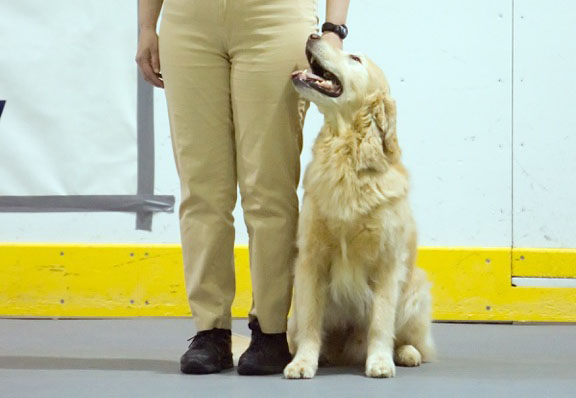
 1. Stepping into the dog – I am not sure what it is that makes many people step into their dog’s space when they halt, but it happens all the time. One way to fix this is to use footwork that cues the dog without getting in his way. I personally use three steps for my halt sequence. Starting on my right foot I place this foot flat on the floor (as opposed to rolling the foot all the way to the toe); this tells the dog “I am about to stop — start sitting”. The second step, my left foot takes a half stride, while brushing this foot along my right foot; this ensures I do not step into my dog. The final step of the footwork is to simply place my right foot beside the left. I like to start this cue with my right foot to help me focus on staying in my track and out of my dog’s. In the picture of Ribbon (isn’t she lovely!) my feet are tight together at the conclusion of the halt sequence so that she can remain in heel position.
2. Not cueing the dog – Using footwork is one way to tell the dog you are stopping, but there are a few other things that can help your dog. The first one is to lean back slightly as you start your footwork. One other way of cueing the dog is to use your eyes. We all tend to look at the dog to see if they are in fact sitting. This sometimes can create a head and/or shoulder turn, which in the ring could be considered a second command. From a training standpoint you don’t really need a cue to be that obvious – our dogs are much more observant. Pick a location on your dog (the left ear, left shoulder) and look (with your eyes only) at that location as you begin all your other cues to halt. This will give a consistent picture for the dog. Yes, that’s correct: if you add in the cues discussed above, I am suggesting that you: Lean back slightly and look at a specific part of your dog while planting your right foot flat on the floor, followed by a half stride with your left foot and lastly bringing your right foot level with your left. I am here to tell you that you can do it. I am not a very co-ordinated person and I can do it! Yes, it takes time until it becomes second nature, but that is the nature of the game. You work at your dog training skills (this is something else to add to the list.) In my books Ring Ready and Rally On I talk about handling, so if you have a copy of those books you can find more information about halts and general handling for heeling.
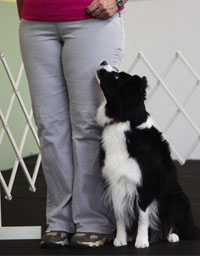
3. Dog does not tuck sit – this is a big one. All the great handling in the world will not give you a perfect sit if your dog doesn’t do this physical skill correctly. In the picture of Gali, my Buhund (isn’t he cute!) you can see that he has brought his rear end under his body in order to sit. This give him the ability to remain in heel 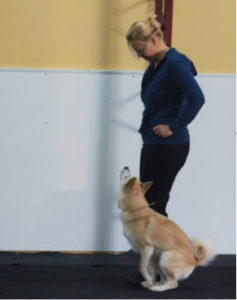 position and be ready to push forward on the next step forward. Essentially a tuck sit means that from a standing position the dog moves his rear feet towards his front feet and remains balanced on all four feet, as opposed to slouching back onto his pelvis. Rocking back onto the pelvis prevents the dog from being able to push forward on the next heeling step, which creates a lag, but I digress… sorry. In the video my new puppy Jett (he is also pretty stinkin’ cute and 6 months old in this video) is learning to do tuck sits; this is the second time he has done it. We make a few mistakes (his front feet are moving) but the last one is pretty darn perfect. You can see clearly that he is learning to use his rear feet to sit. I am holding food in my right hand, to keep his head up and also to provide a balance point to anchor his front end.
Seamless halts can be achieved by improving both your dog’s ability to sit and your own ability to stay out of his way while giving him the information he needs. These skills will go a long way towards raising your scores in obedience. More importantly, your teamwork will improve — because you are being more consistent with your handling, your teammate will be able to pull off his part of the equation: a beautiful straight sit!
Happy Training!